
#3/26 OPEN CONSULTATION MONDAYS, 9 MARCH 2026
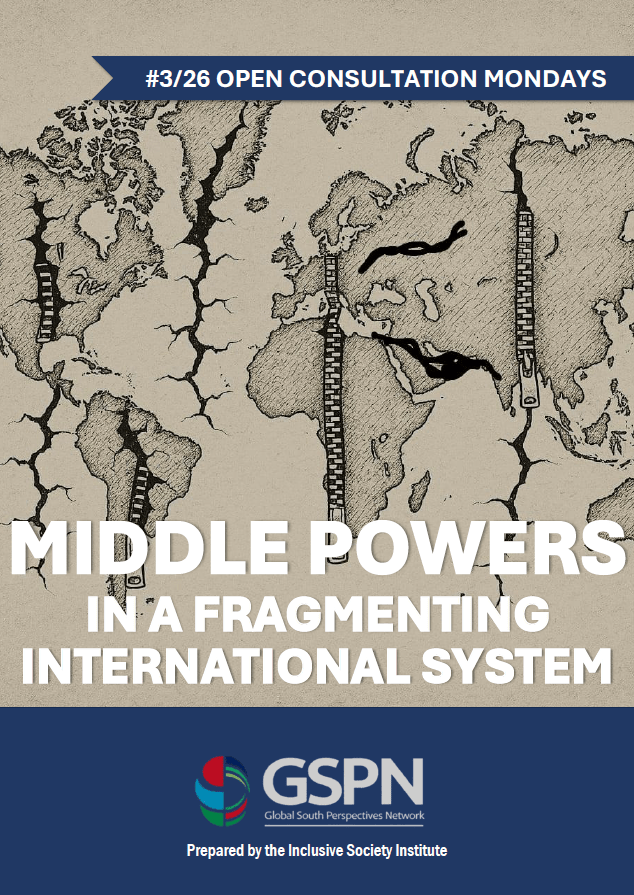
The Global South Perspectives Network (GSPN) report, Middle Powers in a Fragmenting International System, reflects on a dialogue held on 9 March 2026 examining the changing role of middle powers amid growing global fragmentation. It underscores the conceptual ambiguity of “middle powers,” emphasising their wide variation in size, geography and capabilities, while identifying a common reliance on diplomacy, coalition‑building and multilateral institutions rather than unilateral force. Traditionally, these states have played an important stabilising role as intermediaries and consensus‑builders within the multilateral system. Today, however, they operate in an environment marked by accelerating change, where major powers increasingly sidestep established international norms, generating a normative vacuum that undermines the stability on which middle powers depend.
The discussion highlights how recent geopolitical crises, including the wars in Ukraine and Gaza, have deepened uncertainty around international law and weakened confidence in global institutions. Middle powers thus face a fundamental dilemma: they are deeply invested in a rules‑based order but lack the coercive means to uphold it. This tension has revived debates around strategic autonomy and alignment, with many middle powers seeking greater flexibility through non‑alignment or selective, issue‑specific partnerships rather than rigid geopolitical blocs. Domestic political dynamics further constrain their options, as shifts in leadership and internal pressures can rapidly alter foreign policy priorities, as illustrated by cases such as Canada and Brazil.
The dialogue concludes that, despite these constraints, middle powers continue to exercise meaningful, if often understated, influence in global governance. Rather than pursuing formal alliances or ambitious institutional reforms such as UN Charter revision, which face significant structural obstacles, their comparative advantage lies in pragmatic, issue‑based cooperation, diplomatic coordination and the convening of dialogue across geopolitical divides. Their contribution is less about reshaping the global order and more about safeguarding international norms, sustaining multilateral engagement and preserving channels of cooperation. In an era of intensified rivalry and uncertainty, this quiet form of diplomatic entrepreneurship may prove to be one of the most consequential roles middle powers can play.
 Global South Perspectives Network
Leave a comment