
#4/26 OPEN CONSULTATION MONDAYS, 13 APRIL 2026
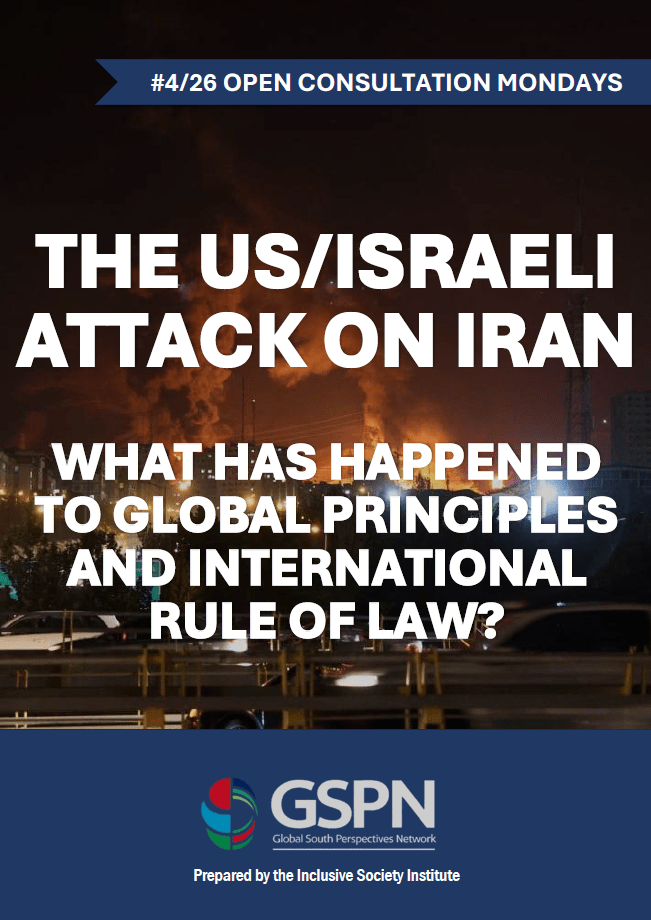
The 13 April 2026 Open Consultation Monday convened by the Global South Perspectives Network examined the US–Israeli attack on Iran as a symptom of deeper stress within the international legal and political order. Led by public international law expert Mona Ali Khalil, the discussion explored how the post‑war rules‑based system is not collapsing outright but is being progressively weakened through the normalisation of exceptions to established norms.
Participants agreed that international law formally remains intact, but its application has become increasingly selective. Powerful states are more willing to reinterpret or bypass legal constraints in pursuit of political or strategic interests, gradually shifting the baseline of what is considered acceptable behaviour. Over time, repeated exceptions reduce expectations of accountability and recalibrate global responses to breaches of international norms.
A central theme was the growing divide between legality and legitimacy. While legal arguments are still advanced to justify state actions, broad acceptance increasingly depends on perceived legitimacy rather than consistent application of law. This has produced visible double standards, particularly affecting Global South states that have historically been subject to strict enforcement of norms without equal protection. The erosion of a shared reference point threatens international law’s function as a common framework.
The discussion also highlighted an enforcement dilemma. International institutions such as the United Nations and the International Court of Justice remain essential for articulating norms, yet they lack the capacity to compel compliance from powerful states. This paradox, institutions being necessary but insufficient, has heightened politicisation and raised questions about their long‑term authority in a changing geopolitical environment.
Selective multilateralism has further fragmented the global order. States increasingly engage with institutions instrumentally, supporting them when aligned with national interests and bypassing them when not. This uneven landscape diminishes predictability and poses particular risks for the Global South, even as it reflects shifting power dynamics.
Participants also noted the growing, though uneven, role of non‑state actors. Civil society, transnational networks and public opinion can influence legitimacy and shape emerging norms, sometimes complementing slow or constrained formal mechanisms.
The discussion concluded that the international system is undergoing adaptation rather than replacement. Core principles such as sovereignty, restraint and multilateral cooperation still matter, but their practical interpretation is increasingly contested. The human costs of this erosion, displacement, insecurity and economic instability, anchored the dialogue, underscoring the urgent need for renewed global leadership and collective resistance to wars of aggression.
*This is a summary of GSPN Open Consultation Monday, held on 13 April 2026. The full report can be accessed here


Leave a comment